
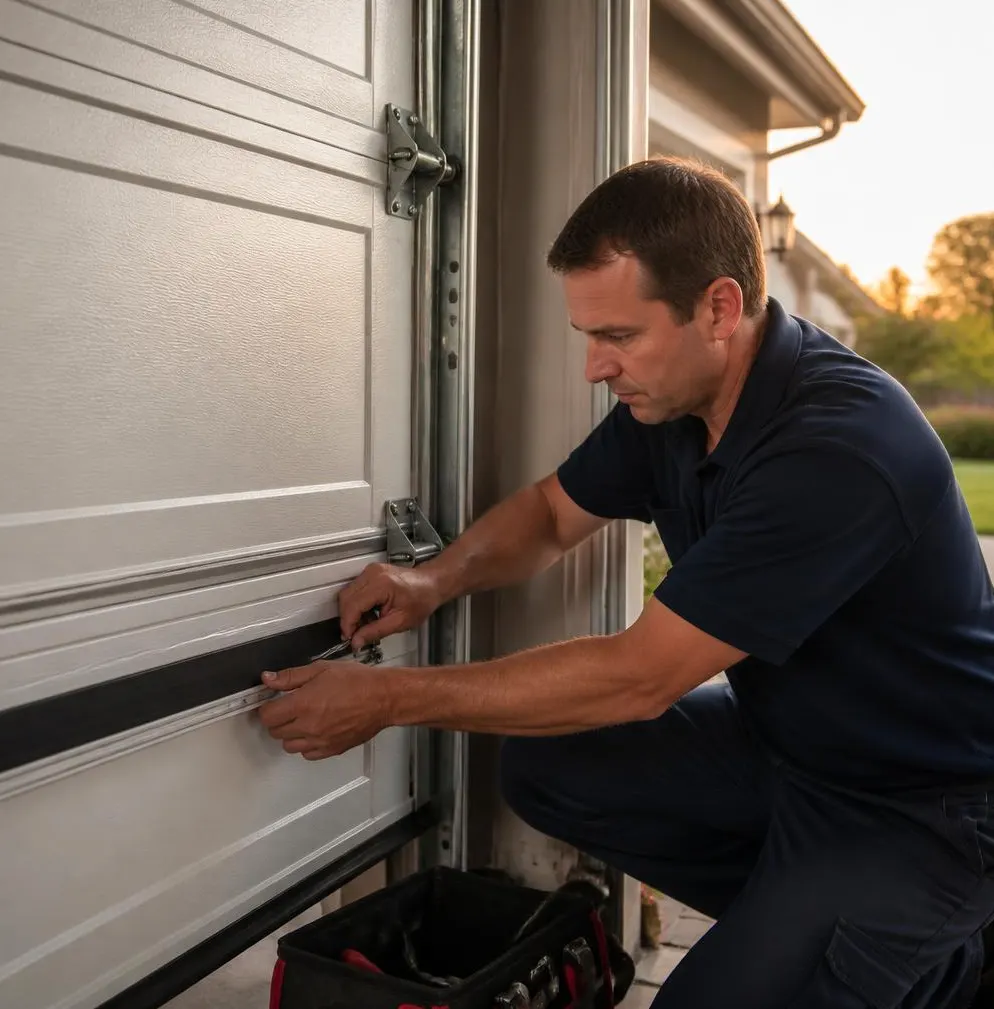
Put this off until January and you'll find out the hard way: a torsion spring that snapped overnight because cold metal lost its flexibility, an opener that won't budge when the circuit board gets too cold, or a door that lets a steady draft into the garage every time an ice storm rolls through. None of these are rare. They're the predictable result of a door that went into winter the same way it came out of summer, with no attention to the parts that actually suffer when temperatures swing. A few hours of maintenance now is cheaper than an emergency spring replacement or a frozen opener repair call in the middle of a cold snap.
Check the Weatherstripping and Bottom Seal
Oklahoma summers bake the rubber seal along the bottom of your garage door, and by fall it's often cracked, flattened, or pulling away from the track. A worn seal doesn't just let cold air in — it lets in dust and blown debris, and during a hard freeze it can let enough moisture through to ice up along the threshold. Run your hand along the bottom seal and the side weatherstripping. If it's brittle, cracked, or has gaps you can see daylight through, replace it before the first real cold front. Replacement seal kits are inexpensive and most homeowners can install them in under an hour.
Lubricate Before the Cold Sets In
Metal contracts in cold weather, and grease or oil that's gone thick and gummy over a hot summer won't do its job once temperatures drop. Rollers, hinges, the torsion spring, and the track all need a fresh application of a garage-door-specific lithium or silicone lubricant — not WD-40, which is a solvent and will actually strip lubrication over time. Pay attention to the top of the springs, where coils rub against each other; that friction point is exactly where cold-weather binding starts. Do this now, before a hard freeze makes the door stiffer and the springs more likely to strain.
Test the Balance Before Spring Tension Gets Tested by Cold
Cold metal loses some elasticity, which means a spring that's already under-tensioned or near the end of its life is far more likely to fail during a winter cold snap than in July. Disconnect the opener, lift the door halfway by hand, and let go. A properly balanced door stays put. If it drifts up or crashes down, the springs are compensating poorly for the door's weight, and winter cold will only make that worse. This isn't a DIY spring adjustment — torsion springs are under enough force to cause serious injury — but it's a five-minute test that tells you whether to call someone before the cold arrives, not after a spring lets go on the coldest morning of the season.
Protect the Opener and Its Backup Battery
Garage door openers have circuit boards and sensors that don't love temperature extremes, and a sudden ice storm that knocks out power is exactly when you need the door to still work. If your opener has a battery backup, check that the battery still holds a charge; most need replacing every few years, and a dead backup battery during an ice-related outage means lifting a heavy door by hand in the worst possible weather. While you're at it, clean the photo-eye sensors near the bottom of the tracks — a buildup of dust from a dry fall, followed by condensation from the first cold snap, can cause the sensors to misread and refuse to close the door.
Look at the Hardware After Storm Season
If wind or hail worked over your door this past storm season, don't let loose hinges, bent brackets, or a slightly warped panel ride into winter unaddressed. A door that's already a little out of alignment will bind harder when cold tightens up the metal and the weatherstripping, and what was a minor annoyance in October can turn into a door that won't close flush in December. Walk the full perimeter, check that every bolt is snug, and look at the tracks for any rust starting to form from summer humidity or storm moisture — rust spreads faster once ice and salt from winter precipitation get involved.
Consider Insulation If You Haven't Already
If your garage shares a wall with living space, or you park a vehicle you'd like to start easily on a cold morning, an insulated door is worth the trade-off. Insulated doors cost more upfront than a standard uninsulated panel door, but they hold temperature better, resist warping from temperature swings, and tend to be sturdier against wind-driven debris. If a full door replacement isn't in the budget this year, a retrofit insulation kit for an existing door is a lower-cost middle option worth asking about.
When to Call Precision Garage Door of Broken Arrow
If your door is slow to respond in the cold, the balance test shows a problem, or the opener and backup battery aren't performing the way they should, that's the point to call in a technician rather than wait. Precision Garage Door of Broken Arrow handles garage door maintenance visits that cover exactly this kind of pre-winter tune-up — lubrication, hardware inspection, balance checks, and weatherstripping replacement — along with spring replacement when a spring is showing its age and isn't going to make it through a hard freeze. We'll tell you plainly whether something needs attention now or can wait, and we fix it right the first time.
Don't wait for a frozen opener or a snapped spring to force the issue. Call Precision Garage Door of Broken Arrow today and get your garage door ready for whatever this Oklahoma winter brings.